
The creator economy is the ecosystem of independent content creators — YouTubers, TikTokers, podcasters, writers, and more — who build audiences, monetise their content, and work with brands as a core part of their business model. It is now one of the most significant forces reshaping how brands reach consumers, and in 2026, it shows no signs of slowing down.
For brands, understanding the creator economy is no longer optional. The channels where your customers spend attention are increasingly creator-led. The content formats that drive the strongest trust and conversion are creator-made. And the tools available to tap into that ecosystem at scale have changed dramatically. This guide explains what it all means for your marketing strategy.
What the creator economy actually is
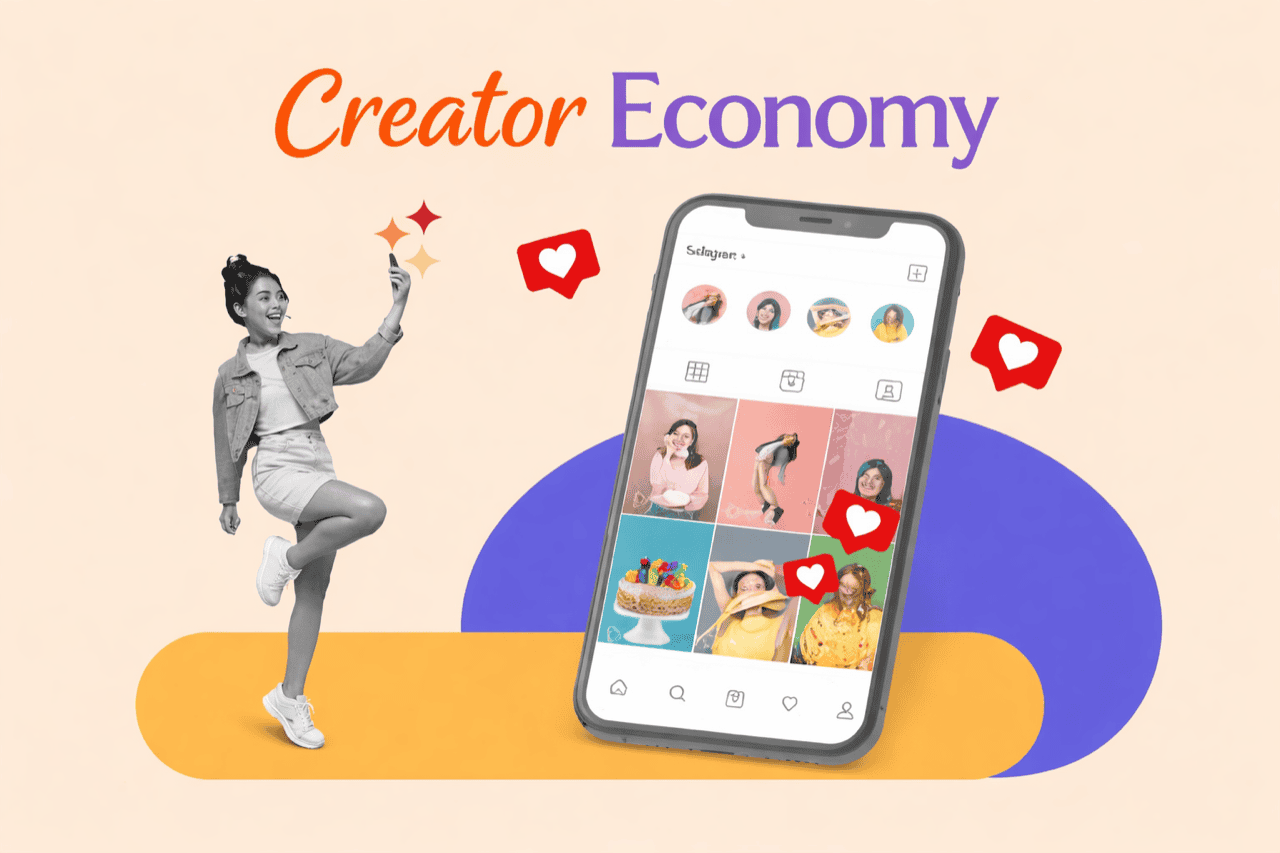
The creator economy refers to the class of businesses built by independent creators who monetise their content and audience. Revenue comes through brand partnerships, platform programmes, merchandise, subscriptions, or their own products.
What makes it distinct from traditional media is simple: the creator is both the publisher and the talent. A YouTuber with 300,000 subscribers controls their own distribution, their own editorial direction, and their own commercial relationships. They are not a freelancer inside a media company. They are the media company.
For brands, this distinction changes the nature of the partnership. You are not buying a placement in someone else’s publication. You are entering a relationship with a business owner who has a direct, trusted connection with their audience.
That shift, from media buy to creator partnership, is what makes creator marketing fundamentally different from traditional advertising. It is also what makes understanding the creator economy essential for any brand marketing team in 2026.
How big is the creator economy?
The scale of the creator economy has grown to a point where it is difficult to overstate.
Goldman Sachs research estimates the creator economy could approach $480 billion by 2027, up from approximately $250 billion in 2023. The growth is being driven by three converging forces: the continued rise of short-form video, the maturation of creator monetisation infrastructure, and brands shifting spend away from traditional paid media toward creator-led content.
Statista data puts the number of content creators worldwide at over 200 million, with a meaningful subset numbering in the tens of millions monetising at a level that constitutes a primary income. This is not a niche channel. It is a global content industry that has grown faster than almost any other media category in history.
For brand marketers, the practical implication is clear. Your customers are spending significant time with creator content. The question is not whether to participate in the creator economy, but how to do it efficiently.
The four pillars of the creator economy
Understanding the creator economy means understanding the four groups it is built around and how each relates to the others.
Creators are the individuals producing content and building audiences on TikTok, Instagram, YouTube, Substack, Spotify, LinkedIn, and beyond. They range from nano-creators with a few thousand highly engaged followers to mega-creators with audiences in the tens of millions. Their value to brands lies in the trust and attention they have earned from their audience over time.
Platforms are the distribution infrastructure: the social networks, video platforms, and publishing tools where creators build and reach their audiences. Platforms compete for creator talent through monetisation programmes, algorithmic reach, and tooling. Their business models depend on the content creators produce, which gives creators increasing leverage in how they shape those relationships.
Audiences are the people who follow, watch, subscribe to, and engage with creator content. What makes creator audiences valuable to brands is not just size but intent. A beauty creator’s audience is, by definition, interested in beauty. A fitness creator’s audience cares about fitness. This self-selection creates the niche alignment that makes creator marketing so effective for targeted campaigns.
Brands and tools form the commercial layer: the companies that partner with creators to reach their audiences, and the platforms that make those partnerships manageable at scale. This is where Scoop (scoop.app) operates. Scoop is an AI platform that automates influencer discovery, outreach, and campaign management for brands, enabling systematic creator partnerships that would be operationally impossible to run manually at any meaningful volume.
What the creator economy means for brand marketing
The creator economy has changed brand marketing in ways that are now structural rather than experimental.
Attention has moved. Time spent on creator-led platforms including TikTok, YouTube, Instagram, and podcasts now rivals or exceeds time spent with traditional media for most demographic groups under 45. Brands that still concentrate the majority of their spend on television, display, and search are spending where attention used to be.
Trust is earned differently. Creator content consistently outperforms branded content on trust and engagement metrics because audiences have a relationship with the creator, not the brand. A creator recommendation carries social proof that a brand advertisement cannot manufacture. This is not a trend driven by novelty. It reflects a durable shift in how people process commercial information.
Content production has decentralised. Before the creator economy, brands needed production budgets, agencies, and media placements to produce and distribute content at any scale. Today, a brand with the right creator partnerships can produce high-quality, authentic-feeling content at a fraction of the cost, published directly to audiences who are already receptive. The full picture of what UGC and creator content make possible illustrates just how far this shift has gone.
Operational complexity has increased. The opportunity the creator economy presents is real. So is the challenge. Managing creator partnerships at any meaningful scale — discovery, outreach, contracts, briefs, content review, payments, and performance measurement — requires infrastructure that most brand teams have not yet built. Closing that gap is one of the defining priorities for brand marketers right now.
How brands are adapting in 2026
The brands doing creator marketing well in 2026 have stopped treating it as a campaign channel and started treating it as a content operation.
Instead of episodic campaigns with new creators each time, they maintain ongoing rosters. Instead of one-off briefs, they build creator relationships that compound over time. Instead of measuring post-by-post, they track creator program performance as a channel with its own attribution and benchmarks.
Brand Strategy Director, consumer brand
The brands that are winning with creators aren’t the ones with the biggest budgets. They’re the ones who’ve built the systems to run the channel consistently: to brief well, to review fast, to iterate on what’s working.
This shift from campaigns to programs is what separates brands that generate occasional wins from those that have made creator marketing a reliable growth driver. Scoop is built specifically for this operating model. Its agentic infrastructure, powered by autonomous AI agents handling discovery, outreach, deal negotiation, content review, and performance tracking, removes the manual overhead that makes running a continuous creator program impractical for most teams.
Brands using Scoop report up to 85% reduction in the time required to manage creator programs. In practice, that means the difference between running two campaigns a quarter and running an always-on program. The creator economy offers the opportunity. Scoop provides the operational layer to act on it at scale.
For brands still building out the foundations, the complete guide to influencer marketing for brands is a practical starting point for putting creator economy participation into action.
Ready to plug your brand into the creator economy at scale? Scoop is the creator marketing platform built for brand teams who need to scale campaigns without scaling headcount. Request a demo at scoop.app to see the full agent workflow in action.