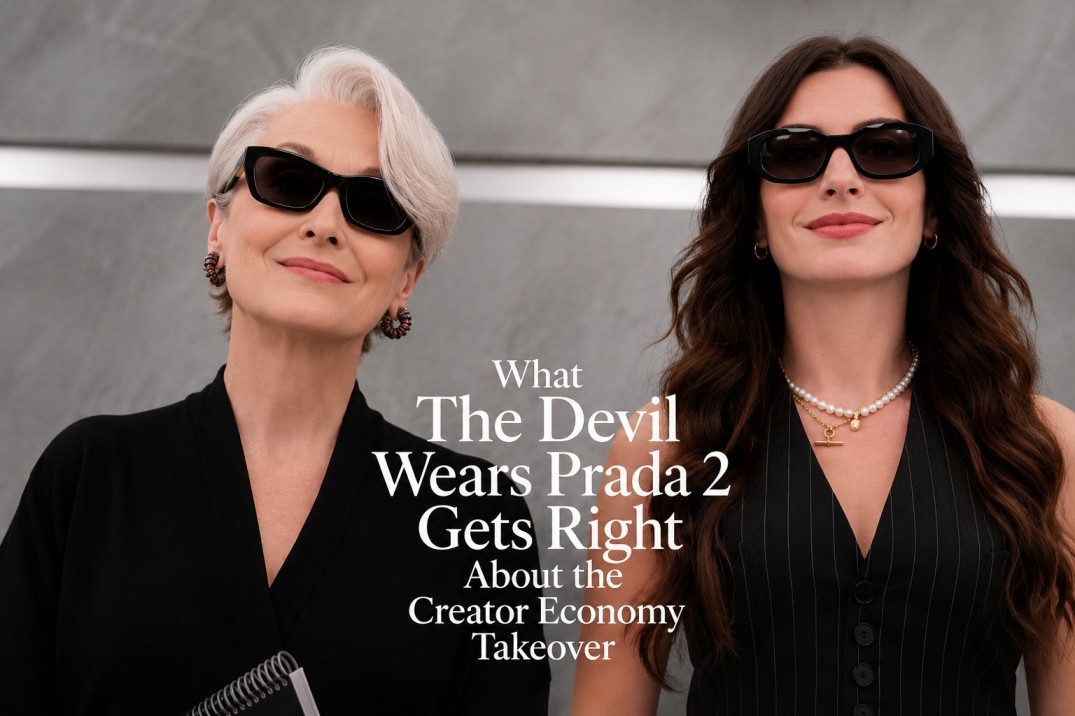

On the surface, The Devil Wears Prada 2 is about a fashion magazine. About clothes, and ambition, and the particular kind of person who treats a wrong font choice like a federal offence. It is very good at being that film. Meryl Streep makes every line feel like a verdict. The coats are extraordinary.
But the film that opened to $77 million last weekend is not really about fashion. It is about something that anyone running a brand in 2026 will recognise immediately — even if they have never once thought about what goes on a Runway cover.
It is about what happens when the rules of who gets to be important suddenly change. And what you do if you built everything on the old rules.
The World the First Film Was About
The original Devil Wears Prada, released in 2006, was about access. Miranda Priestly had it. You wanted it. The entire machinery of fashion, of media, of culture ran on who she let through the door. A cover could make a career. A dismissal could end one. The power was real, concrete, and concentrated in a single person sitting behind a single desk.
That world made a kind of sense. Attention was scarce. The number of places a brand or a designer or a model could become known was genuinely limited. The gatekeepers were powerful because the gates were real.
Twenty years later, the sequel opens, and Miranda is still at that desk. The coats are still extraordinary. And the gates are gone.
What the Sequel Is Really About
We are not going to spoil anything. But here is what the film is wrestling with, openly and seriously, for two hours: what does it mean to have taste, expertise, and genuine authority in a world where relevance is measured in engagement rates?
The film watches a character who built everything on the quality of her judgment now having to justify that judgment to people who measure quality differently — who count, rather than evaluate. One character in the film delivers a line that has been circulating online since opening weekend, about what happens to an industry when you strip out everything that does not produce an immediate number. It is not a cheerful observation.
The villain of the sequel, to the extent there is one, is not a person. It is a logic. The logic that says a piece of content has met the bar when it is performing, and has not met the bar when it is not. The logic that replaced editors with algorithms, newsrooms with content operations, expertise with velocity.
Miranda’s reckoning with that logic is what the film is about. Not fashion. Relevance. And who gets to decide what it means.
Why This Lands So Hard Right Now
The film is not subtle about its timing. Newsrooms are collapsing. Publications that defined culture for decades are being acquired by people who want a vanity project and then gutted when the vanity fades. A line early in the film about what happens when a company decides that soul is a cost centre got audible reactions in cinemas.
This is the media industry in 2026. And it is not unrelated to what has happened in brand marketing.
For decades, brands that wanted to reach people borrowed authority from institutions. You placed a spread in the right magazine and you got proximity to that magazine’s audience and credibility. The magazine was Miranda. The readers trusted the magazine. That trust was transferable, in a limited and expensive way, to whoever was advertising inside it.
Then creators happened. And the authority did not disappear. It redistributed. Across millions of individual people who built their own audiences, their own credibility, their own relationship with their followers that no institution facilitated and no institution could revoke.
The question the film is asking about fashion media is the same question brand marketers have been asking, less eloquently, for the last eight years: what do you do when the audience trusts the person more than the publication?
This Is Exactly What Influencer Marketing Is
There is a word for what happened when cultural authority moved from editors to individuals. It is influencer marketing. And the reason the industry has spent a decade arguing about whether it works, how to measure it, whether it is real or manufactured, is because the underlying shift it represents is genuinely disorienting.
An influencer is not an advertisement. They are not a placement. They are a person who has built a specific kind of authority with a specific audience, and brands that understand this treat the relationship accordingly. The influencer knows their audience better than the brand does. Their voice is what makes the content perform. Their credibility is the whole point, and it does not transfer if the content does not sound like them.
This is Miranda’s world, except the editors are beauty creators and fitness creators and finance creators and every other niche with a person at the centre of it who has spent years earning the trust of an audience that genuinely cares what they think. The authority is the same. The scale is incomprehensibly larger. And the brands that figured this out earliest are now running programs with dozens or hundreds of these relationships simultaneously, compounding every quarter.
The ones that have not figured it out yet are still treating influencer marketing like a media buy — briefing creators like copywriters, measuring success like they measure a banner ad, and wondering why the results feel thin.
What It Means If You Are Building a Brand in 2026
The film does not resolve this question neatly. Miranda does not simply adapt and thrive, because that would be dishonest. But it also does not romanticise the old world. The expertise was real. The new world is also real. Both things are true at the same time, and figuring out how to hold both of them is the actual work.
For brand teams, the practical version of this is: influencer marketing is not a trend that arrived and will eventually leave. The redistribution of cultural authority from institutions to individuals is structural. The brands building durable influencer programs are not treating creators as a new ad placement. They are treating them the way smart fashion houses eventually had to treat editors — as genuine partners with their own audiences, their own authority, and their own creative voice that cannot be scripted without destroying the value of the partnership.
What it actually takes to run a creator program at the scale this moment requires is the operational question underneath all of this. The strategic case for creator marketing has been made. The gap, for most brands, is the infrastructure to do it continuously rather than episodically, at scale rather than experimentally, in a way that compounds rather than resets.
Miranda Priestly built an empire on taste. The film asks what taste is worth when everyone has a platform. It does not give a comfortable answer.
But the brands figuring it out are not waiting for one.
The Devil Wears Prada 2 is in cinemas now. No cerulean sweaters were harmed in the writing of this post.