
The phrase “AI-powered” has been attached to almost every marketing tool in the last two years. Discovery platforms added AI search. Outreach tools added AI message drafting. Analytics platforms added AI-generated insights. The AI is real. The automation isn’t.
There is a meaningful difference between a tool that assists a workflow and a platform that runs it. Understanding that difference — and why it matters right now — is what separates the marketing teams who will scale creator programs efficiently from those who will keep hiring to keep up.
What “agentic” actually means in influencer marketing
An agent, in software terms, is a system that can take actions autonomously, within parameters the user sets, and adapt based on what it finds. It doesn’t wait to be told what to do next.
An agentic influencer marketing platform is not a platform with AI features added on. It is a platform where AI agents complete campaign tasks and not just assist with them.
The test is simple: does the AI complete the task, or does it suggest the next step for a human to take?
In an AI-assisted tool, the human still does the work. The AI makes it marginally faster. In an agentic platform, the agent handles the execution. The human reviews the output, approves at decision points, and moves on. The operational work that is the searching, the outreach sequencing, the back-and-forth negotiation, the draft compliance checking would runs without manual input.
That is the distinction that matters. Everything else is marketing copy.
Why brands need agentic infrastructure in 2026
Influencer marketing is growing. HubSpot’s State of Marketing report consistently shows creator content outperforming traditional paid channels on engagement and trust metrics.
The problem is that the operational model hasn’t kept up with the spend.
A mid-scale influencer campaign requires 15 to 40 hours of manual discovery work per round, before a single outreach message is sent. This isn’t a niche problem but it’s a systemic one that affects most marketing teams regardless of budget or team size. For brands running three or four campaigns in parallel, that overhead doesn’t just slow things down. It sets a hard ceiling on what the team can run.
Rising CPMs across paid social have pushed more budget toward creator marketing precisely because it scales better in theory. In practice, the manual workflow bottleneck means most brands can’t actually scale it. They run the same creators on repeat, accept the first shortlist they build, or hire more people to absorb the volume.
The agentic model is the structural answer to this. When AI agents handle the execution layers of a campaign, the brand team’s capacity shifts from doing the work to reviewing the output. The throughput ceiling goes up. The headcount requirement doesn’t. For a closer look at why manual discovery specifically doesn’t scale and what the cost actually is, the numbers are worth reading before the next campaign brief lands.
What an agentic creator campaign looks like in practice
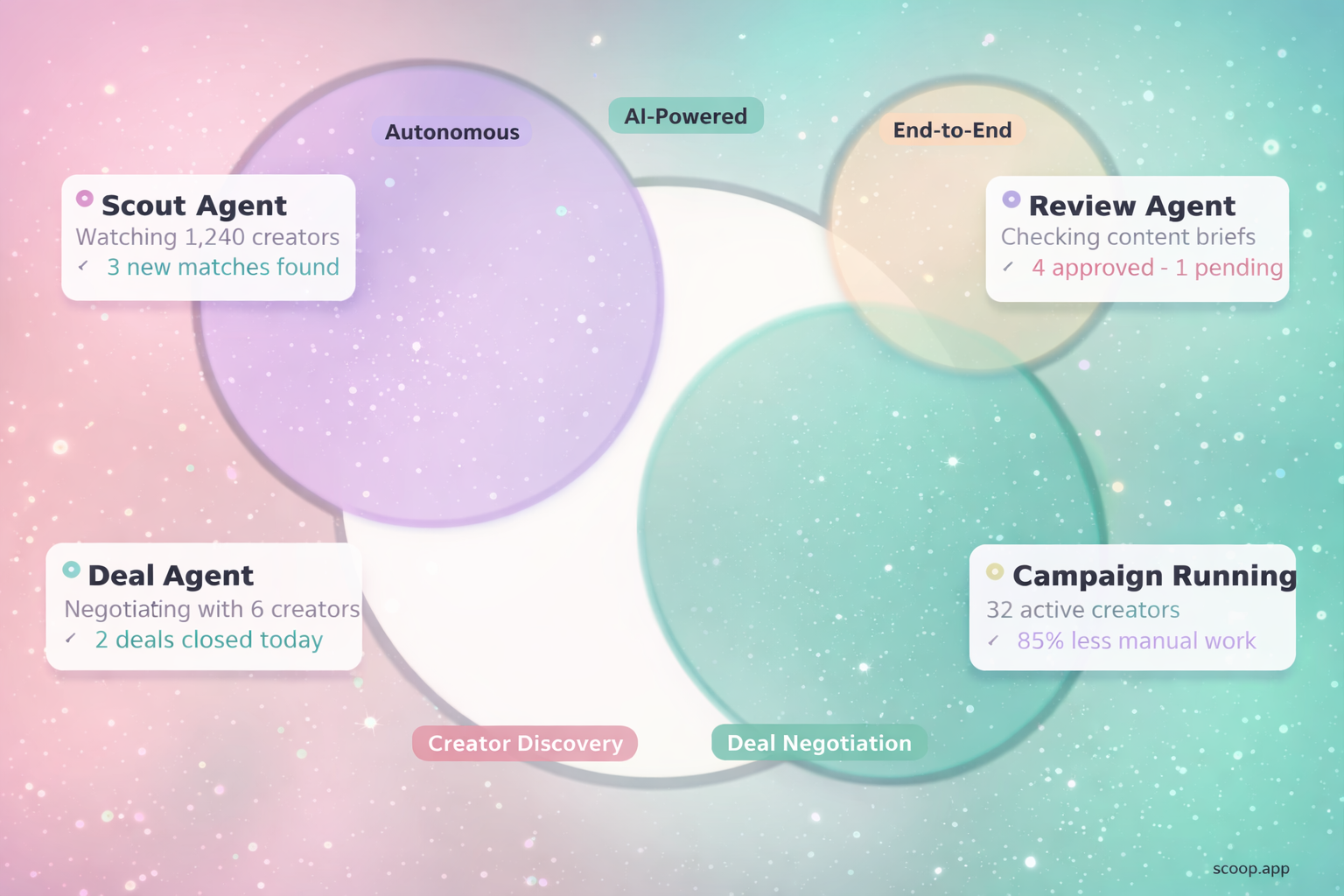
On Scoop scoop.app, a creator campaign runs through a sequential three-agent workflow. Here is what each step looks like:
1. The brand sets campaign criteria — content format (comedic, conversational, authentic), tone (relatable, professional, high-energy), output type (UGC, product showcase, how-to), budget range, deliverables, and timeline.
2. Scoopy Scout runs discovery sweeps — the discovery agent watches creator videos on Instagram and TikTok, evaluates them against the campaign criteria, and returns a confidence-scored shortlist. No scrolling. No spreadsheet.
3. The brand reviews the shortlist — each creator comes with a confidence score and the agent’s reasoning. High-confidence matches can be auto-approved against a threshold the brand configures.
4. Deals handles outreach and negotiation — the negotiation agent sends personalised outreach, manages counter-offers within the brand’s budget parameters, and escalates to brand marketing handlers when deal terms exceed the walk-away threshold.
5. The creator receives a structured deal package — campaign brief, deliverables, content guidelines, and payment terms, all in one place. Three actions: accept, counter-offer, or decline.
6. Scoopy Review checks the submitted draft — the AI content review agent evaluates the draft against the campaign brief and guidelines before the brand sees it, flagging specific mismatches and requesting revisions directly from the creator while the brand can add manual comments also if needed.
7. The brand approves compliant content — by the time a draft reaches the brand, it has already passed a structured compliance check. Reviews are decisions, not first-pass triage.
The campaign brief defined in step one feeds every agent downstream. Scoop uses it to find creators. Scoop Review uses the same brief to evaluate their work. The criteria are consistent from first search to final sign-off. Scoop is an AI platform that automates influencer discovery, outreach, and campaign management for brands and that automation reduces creator marketing effort by up to 85% across the full campaign lifecycle.
Why legacy platforms can’t close this gap by adding AI features
Platforms like GRIN, CreatorIQ, and Aspire.io have introduced AI capabilities over the past couple of years improving search, generating message drafts, and summarizing performance. These are meaningful enhancements that make existing workflows more efficient.
However, most of these implementations are still assistive rather than autonomous.
The challenge is largely architectural. Traditional influencer marketing tools were built as creator databases and campaign dashboards. Their core function is to store data, display metrics, and support communication. In this setup, the workflow is still human-led, with AI providing recommendations that the user acts on.
Moving toward a more agentic model, where workflows are executed with a higher degree of autonomy, typically requires deeper changes to how the system is designed. Instead of AI being layered onto existing processes, it becomes more embedded within the workflow itself.
That doesn’t mean legacy platforms can’t evolve in this direction, but it often involves more complexity and incremental change compared to platforms that were designed with automation in mind from the outset.
Scoop, for example, positions itself as agentic-first, where automation is more central to how workflows are structured. This reflects more of a structural difference in approach rather than just a feature-level distinction.
What to look for in an agentic influencer marketing platform
Three markers distinguish a genuinely agentic system from an AI-assisted one with stronger marketing claims.
First: agents that complete tasks, not suggest them.
A discovery agent that returns a shortlist and can auto-add creators to a pipeline is agentic. A ranked search result is not. Ask whether the AI takes the action or flags it for a human.
Second: human-in-the-loop controls that preserve oversight without removing autonomy.
On Scoop, every agent action queues with a confidence score, the agent’s reasoning, and a countdown to auto-execution. Brands can approve, reject, or override. They can also set confidence thresholds, reaction time windows, and daily rate limits — calibrating exactly how much they trust the agent’s judgement at each stage.
Third: a shared brief layer that runs the full workflow.
In a genuinely agentic platform, the campaign criteria feed discovery, negotiation, and content review from the same source. The brief isn’t in a separate document the agent occasionally references. It is the operating input for every agent in the sequence.
If a platform passes all three, it is agentic. If it passes one, it is AI-assisted with a good pitch deck. The difference shows up in how much time your team spends on execution versus decision.
Ready to see how an agentic campaign runs? Scoop is the creator marketing platform built for brand teams who need to scale campaigns without scaling headcount. Request a demo at scoop.app to see the full agent workflow in action.